Monday, September 20, 2021

ACHIEVING ENERGY INDEPENDENCE?

The Westminster government is to hold urgent talks (Saturday 18th September) with the energy industry amid growing concern about a spike in wholesale gas prices. Kwasi Kwarteng ( the Business Secretary ) will talk to gas suppliers and others on Saturday to hear how wide-reaching the impact of the surge in prices could be. The combination of high global demand, maintenance issues at some gas sites and lower solar and wind output are blamed for the rise. 


A knock on effect of the price rises is that two large UK fertiliser plants to close. The Westminster Government sources have stated there is no threat to UK gas supplies and the impacts on small energy companies that might be the most exposed are being monitored. Westminster government officials are looking at whether products that could end up being in short supply, such as fertiliser, could be imported from abroad.


Natural gas prices are at currently at record highs as economies around the world begin to recover from the Covid crisis. In the UK, lower winds have meant less renewable energy is generated. There have also been outages at some nuclear stations and lower flows into the UK of natural gas from Norway, pushing up the price of natural gas. Another thing to consider is that at some point there will be a significant rise in domestic energy bills. 


Saturday’s discussions with senior figures from the UK's energy sector were requested urgently with the chief executives from gas producers, the National Grid, suppliers including Scottish Power, EON and EDF and the regulator Ofgem to hear how far-reaching the impact of the surge in prices is likely to be.


The high prices have led to fertiliser plants in Teesside and in Cheshire to close, leading to a major drop in supplies of carbon dioxide gas - a by-product of fertiliser production - which is used across many industries. Meat processors are also in talks with the government over this carbon dioxide shortage because of its use in the meat production process. The gas is used to stun pigs and chickens prior to slaughtering and also in the packaging and preserving process.


A national energy company for Cymru / Wales


There is is still an opportunity to develop a different vision for energy and the environment for a Wales that reduces its carbon emissions, harnesses its natural resources sustainably, and seizes opportunities in the low-carbon and circular economies. The link between energy and climate change is clear. A number of actions could fall into the remit of Ynni Cymru, including: reducing the cost per unit of energy to homes and businesses in Wales, reducing the consumption of energy in homes and businesses and helping consumers to make informed decisions based on smart metering technology.


Ynni Cymru should be tasked with funding the mass installation, outsourced to local companies, of solar panels on the roofs of households, business premises and lampposts in Wales, beginning with public buildings and social housing. The company would coordinate and facilitate the use of publicly owned land for renewable energy purposes. 


The company could finance the acquisition and development of new large-scale generating and storage capacity, ensuring Wales becomes self-sufficient in renewable energy and becomes a renewable energy exporter. It could boost our energy market by ensuring the development of a national producer cooperative among community energy organisations.


The problem we face is that our energy production and distribution model has been effectively restructured to primarily benefit the big 6 energy cartel members, their interests and their (City) profits. From the perspective of energy consumers and smaller scale energy producers, or anyone who wants things to change the problem is that all the Westminster focused political parties have happily bought into this cartel dominated model of energy production and ownership (or perhaps more truthfully were quietly bought).


The energy sector is quite simply warped to favour the larger providers - it is very difficult to break into a sector that is dominated by large companies that are favoured by the Westminster government,  At the beginning of 2021 there were 70 energy suppliers in the UK. Industry sources have said that there may be as few as 10 left by the end of this year.  The reality is that the UK’s cartel dominated model for energy production and distribution is not necessarily the norm everywhere in Europe or around the world. 


Now contrary to what you might think, and tend hear from Westminster and much of the UK media; realistic alternatives exist and actually prosper, a particularly good example of a balanced and healthy energy mix can be found in Germany. Small may very well be beautiful, even with a geographically sizeable state, especially in relation to energy, in 2012 some 22% of the countries energy came from small scale green entrepreneurs, by 2019 it was 46%.


Community based co-operatives (both urban and rural), farmers and homeowners are part of the 1.3 million renewable energy producers and part of the energy mix. In Germany, citizens’, cooperatives, and communities own more than half of German renewable capacity. Small-scale electricity generation is having a knock on effect encouraging change throughout the energy system.


Citizens’ owned energy in Germany involves:  


  • Private individuals or farmers (jointly or individually) invest in energy facilities
  • The investment is made with the citizens own capital, which gives a certain level of control over the project
  • Citizens own at least 50 percent of voting shares
  • Citizens have a connection to the region where the facility is operated


In Berlin, a cooperative (Burger Energie Berlin – literally Berlin Citizens Energy) continues to strive to take control of the capital's electricity grid with some 35,000km of underground cables. The cooperative is a free, cross-party coalition of citizens who are committed to a sustainable, sustainable and democratic energy policy in Berlin. Members have one vote regardless of the amount their deposit and anyone who wants the power network to be in civil hand, is welcome.


Burger Energie Berlin - literally Berlin Citizens Energy


Ordinary Berliners have invested their cash in the venture with the intention of producing a reliable 100 per cent renewable energy supply. The aim is to promote the integration of renewable energy into the grid and to invest a portion of the profits from this directly into the transition to renewable energy. After some serious campaigning, on the 5th March 2019 the Berlin electricity grid was awarded to Energie Berlin. 


This is grass roots energy generation that has potentially the power to change the nature of the energy supply system (in Germany and elsewhere). The aim to build an energy grid that is better handle the rise of green power and allows local use of locally produced energy. This may well be a case of small being both beautiful and perhaps deeply disturbing from the perspective of Westminster and Cardiff Bay something that can be both community beneficial and community owned. 


There is no practical reason beyond ‘thats not the way its done here’ why people living here and Wales could not benefit from membership of citizen owned energy co-operatives. In Germany, there is a deliberate promoted policy of energy transition (or ‘Energiewende’) – this is a very different approach to what is practised in these islands (at least south of the Scottish border). For a start the ‘Energiewende’ is driven by a desire to reduce and eliminate any dependency on nuclear energy.


The introduction of the Feed-in-tariff (EEG) in 2008 was an important part of this process, along with (post Fukushima) the almost unanimous across the board political commitment to a wide range of targets (in 2011) which included a commitment to reduce energy demand (with a 50% reduction in primary energy use by 2050) and the achievement of an 80% renewable electricity share of total consumption (by 2050). This has resulted in a significant uptake of renewables in Germany.


The real striking difference is that the operation of the grid in Germany means that generated renewable electricity is used first and that distribution network operators (DNOs) are also seeking to reduce demand. This is so radically different from the way the energy is generated, distributed, exported and used here in our country that it no doubt, at least from their limited perspective, quite understandably frightens Westminster focused politicians, the civil shrive and the city.


A significant difference, aside from the scale and pattern of investment (in Germany), is that small businesses, co-operatives, individual households and local authorities benefit from investment distributed by a network of local banks (again something we pretty much entirely lack here in Wales). The whole thing has been supported by the KfW (state investment bank) to the tune of 23.3 billion euro in the area of environment and climate protection.


These developments are a million miles away from the so-called ‘Free market’ for energy that exists in the UK, which is pretty dominated by the ‘Big 6’ energy cartel members. The fact that some former politicians have found rather rewarding post political career employment within the energy sector may be co-incidental but suggests that there is little desire for improvement within Westminster and perhaps a complete lack of understanding of the concept from any Labour in Wales government(s) be they previous, current or future. 


The way the current set up works, it is difficult to imagine ‘a Government’ at most levels (at least outside of Scotland in the UK grasping the concept, the practicalities and real possibilities of genuine community owned beneficial energy generation projects. Pending some real change in the way energy policy works we are all pretty much trapped with a real lack of meaningful choice or realistic alternatives when it comes to customers securing domestic energy from the big 6 cartel members.


What we have had over the years has been visionless New Labour, Conservative-Lib DeM and then Conservative governments in Westminster, which have remained hand in glove with despotic oil and gas-producing regimes in the Middle East ( aside from the vassal like relationship between the UK and Saudi Arabia ) who have had has little real interest in renewables. 


The relationship between the energy cartel members and the Westminster government’s is close to being corrupt. Teresa May’s wobbly and unstable Brexit fixated Westminster government, was followed by Boris Johnson’s majority Conservative government which continues to actively work to pull the rug out from under the renewables sector something that has cost highly skilled jobs here in Wales. 


Things need to change as the exceptionally comfortable lucrative relationship between the Westminster focused political partisans the big 6 Cartel members has done all of us no favours over the last twenty years. It has also despite some progress failed to deliver energy independence for these islands, which are still far to dependent of hydrocarbons from unstable regions of our planet and some very questionable despotic regimes, with whom Westminster is quite happy to deal with. 

Monday, August 30, 2021

THE URBAN SPONGE

We need to build into our communities the resilience to cope with flooding - sadly in a warmer wetter world - flood events are going to become more common - we need to think and act smarter, with shifting the focus from flood prevention to flood avoidance. Our communities, our nation and our world are becoming more prone to extreme weather, torrential downpours and periods of warmer or hit dry weather. 


Dealing with the consequences of this on a marco level is one thing.  Small relatively simple steps to store water for later use, with water butts (if only to water garden plants and vegetables) can make a very practical if minor use of excessive rainfall and runoff if only very locally.  Aside from helping to save water and to cut water bills.


Local water storage and management is increasingly part of intelligent urban design, something that is becoming more common and necessary in a warmer wetter world.  On a larger scale this is something we will all have to do, naturally some people and nations are a head of the curve when it comes to re-engineering their infrastructures to deal with extreme weather events. 


The concept of the sponge city or urban sponge. something that is embedded and central to urban planning should now be coming into its own, particularly in Wales, with our urban areas being redesigned or designed from the start to soak up, and store deluges of torrential rain to prevent damaging and dangerous flash flooding but without the construction of large scale flood defences.  


The Dutch, for historical and geographical reasons have been involved in serious water management for centuries. Yet in a warmed world, even the Dutch are having to take long hard fresh look at how they deal with the consequences or severe weather and more regular flooding. 


Many urban areas have developed with any serious co side ration of the impact of flash flooding - back in July, in localised parts of London heavy torrential downpours saw local drainage systems overwhelmed - as streets became rivers, homes and businesses were flooded and public transport ( including trains and tubes ) brought to a standstill. In London, heavy rain, which fell on hard surfaces, overloaded drainage and severe flooding resulted. 


Elsewhere things are done differently - the songs city concept has been embraced in parts of Berlin, were green roofs have been created with living plants, mosses and grasses, with plants Boeing on vertical walls, with courtyards planted with vegetation, etc - all of which helps to hold and slow excessive water. One beneficial side effect, if that the retained water helps to cool local neighbourhoods as the water evaporates from vegetation and the ground. 


In the Netherlands, the concept of making room for the river has been embraced to give space for flooding, something which slows the speed of riverine flooding. In Amsterdam, they have constructed rain gardens which have been created from parking areas, which are designed to collect water, people have also been encouraged to remove paving from their gardens, to grow plants and to build ponds to help with runoff and water storage. 


In the city of Rotterdam, public places have been turned into what are called water plazas which turn into shallow lakes during periods of heavy rain, when times are drier these locations are used as public parks and playing fields. Underground car parks have been redesigned or specifically built so that lower levels can be used to store storm related flood waters - which can then be pumped dry when water levels have dropped. 


These concepts are only slowly being looked at a adopted within these islands, we still tend to defy logic and build on flood planes, but, tend not to harden infrastructure of buildings ( commercial and domestic ) or to build with flooding in mind  e.g. build smart using ground floors for storage or parking and raise plug and power points, protect utilities and drains, and put washing machines, fridges sand freezers up off the ground. 


Some urban areas, within these islands, have slowly begun to adopt the concept, there are examples in Llanelli and at West Gordon Park, near Manchester - were porous pavements, shallow depressions, grass berms and small ponds help to absorb and direct surplus water into rain gardens or natural sumps or green spaces that double up as parks in drier periods. 


These are small steps, in a warmer, wetter world with more erratic and extreme weather events the problem of flooding will only get worse. As homeowners pave over their gardens for parking spaces the problem will worsen. The concept of the urban sponge is one that we all need to embrace, along with smart design and smart water management to help to reduce or alleviate urban flooding. 

Thursday, August 26, 2021

MISSED ANNIVERSARIES, MISSED OPPORTUNITIES

The end of August is a time of historic anniversaries, admittedly somewhat overshadowed by the drama and tragedy surrounding the collapse of Afghanistan and the fall of Kabul, normally its a time of often ignored or perhaps selectively not remembered anniversaries and interlinked missed opportunities. 


The last few days have seen anniversaries for the Soviet invasion of Czechoslovakia (in August 1968) and the collapse of the Soviet Union (in August 1991) pass largely unremembered. 


On Saturday 21st August 2021 it was the 53rd  anniversary of the Soviet led invasion of Czechoslovakia, it’s an anniversary that these days increasingly passes largely unnoticed save perhaps by some people in Prague. Now that the Soviet Union is history, although Russia on the rise in the east, people have lots of other things to be concerned about.  It’s been 53 years since Soviet troops and most but not all of their Warsaw Pact allies invaded Czechoslovakia on August 21st 1968. 


The Soviet-led invasion effectively established the Brezhnev Doctrine, which Moscow said allowed the U.S.S.R. to intervene in any country where a Communist government was under threat. The Soviet backed occupation of Czechoslovakia lasted until the velvet revolution brought an end to the Communist dictatorship in November 1991 as the Cold War ended. It was always contested - the reformist communists were finally defeated in the mid 1970's just as detente created the Helsinki accords which inspired Charter 77. Russia’s attitude to the invasion still touches raw emotions, evens in the Czech and Slovak republics. 


The thirtieth anniversary of the collapse of the USSR largely passed unremembered, in both the West and more importantly in Russia, the reasons for Russia’s desire to forget the past are understandable. The Brits lost their Empire fifty years ago, and some of them have not got over the losing of it. The Russians lost their Empire in a fortnight, which must still sting a bit, even thirty years down the line. 


The West was strangely silent when it came to remembering the anniversary of the collapse of the USSR. Perhaps considering the hubris displayed at the time and the wilful glee the came with the dismemberment of the old Soviet state industries and assets, the rise of the oligarchs (some of whom were very close and comfortable with New Labour and still comfortable with he Conservatives and the rise of President Putins new Russia, the silence is understandable. 


The it comes to anniversaries August may be the month that keeps on giving on the Monday 23rd August 2021 was the 82nd anniversary of the 1939 the signing of Nazi Germany’s and the Soviet Union’s pact which effectively guaranteed the start of the second world war. The event is remembered the Baltic republic and Poland but very rarely anywhere else, especially in the Russian Federation, where history is both important and selectively remembered. 


When the Poles held a commemoration of the 75th anniversary of the start of the Second World War, world leaders gathered, but the Brits did not go, obviously other important things to do and remember. 


Human history is understandably complex, and remembrance is important, forgetting is very human and is part of life, but, remembrance should be balanced rather than selective. Selectively forgetting the past and erasing our collective history is a more dubious practice ( especially in these islands, Hungary, Russia and the Peoples Republic of China, etc ) but also within these islands, especially when it comes to ‘Brit washing’ the perceptions of and the grim realities of Empire, etc. 


Even in the West, the elite can be very selective about the anniversaries and the history they wish us to remember. Creating a rose tinted view of the past, is neither history nor remembrance, its manufactured / peddled nostalgia - and that too is both dubious, dishonest and potentially dangerous. 


Hence the urge to remember the first day of the Somme, Passchendaele, the Dunkirk spirit, the Battle of Britain (all absolutely important to remember, in their correct historical context) - to reimagine these islands past simply to distract people from the mess the Westminster elite have got us into since Suez, the invasion of Iraq in 2003, the financial collapse of 2008, etc is unacceptable but nothing is quite as unacceptable as blatantly lying and manipulating evidence to justify a war. 


Other less reputable awkward embarrassing anniversaries are ignored or effectively selectively airbrushed from history e.g. the Sykes-Picot-Sazanov agreement, the anniversary of  Amritsar, bloody Sunday, etc.  


For most of the last 20 years successive Westminster governments worked hard to ensure that our service personnel have had a much higher profile, making use of various important anniversaries of previous conflicts, sporting occasions and regularly promoting armed forces day. That emphasis had effectively ceased as the  direct involvement of UK service personnel in the cycle of Blair’s wars has finally wound down save for covering the evacuation.


It is important to remember how we ended up in this mess and who made those decisions. It is equally important that we remember that Westminster (with the honourable exception of the 1945 Labour Government) has often neglected our war veterans after previous war’s ended and faded into memory. We all still need to work to ensure that never again does a Westminster Government makes the decision that dead heroes are cheaper and less trouble to remember than live ones.

Monday, August 16, 2021

THE AFGHAN TRAGEDY

When it comes to the on-going Afghan tragedy, a few quotes spring to mind, Karl Marx said "Hegel remarks somewhere that all great, world-historical facts and personages occur, as it were, twice. He has forgotten to add: the first time as tragedy, the second as farce." Winston Churchill said, "Those that fail to learn from history, are doomed to repeat it" and “Men occasionally stumble over the truth, but most of them pick themselves up and hurry off as if nothing ever happened.” When it comes to Afghanistan there is more than enough history to provide enough examples of what to do and what to avoid.


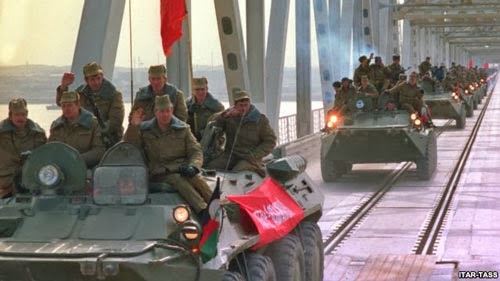
The long and bloody history of Afghanistan is littered literally with the would-be invaders who came to grief and eventually through in the towel and admitted defeat. Back in May of this year, almost unnoticed an anniversary passed, Wednesday 15th May 2021 was the thirty third anniversary of the start of the then Soviet Union’s nine month long withdrawal from Afghanistan. Around 100,000 Soviet troops had left the war torn country by February 15, 1989. This was the conclusion to ten years of brutal warfare which had killed over 14,000 Soviet soldiers and hundreds of thousands of Afghan combatants and civilians.


The Soviet withdrawal in 1989


NATO forces had been on the ground in Afghanistan since the 7th October 2001, and preparations for NATO’s withdrawal (which were originally to be completed by 2014) were finally if hastily completed this summer. Unlike their Soviet predecessors who treated much of Afghanistan as free fire zone, NATO forces were relatively restrained when it came to using their firepower - although many Afghans might have begged to differ. Despite this many people have argued that just like their Soviet predecessors NATO troops in Afghanistan found themselves engaged in waging a campaign which was "unwinnable in military terms".


‘Lessons from Afghanistan’s History for the Current Transition and Beyond’ was a thought provoking paper produced by the MOD Development, Concepts and Doctrine Centre (in May 2013) it made interesting reading.  The paper noted that between 1933 to 1973, Afghanistan was stable and reasonably effectively governed, however, that stability was firmly anchored in the two pillars of traditional local governance and the Afghan state such as it was a weak centralised though weak state, both of which were gravely damaged after 1978.


Afghanistan history’s is littered with a series of chronic succession problems and associated conflict, the presidential election in 2014, saw the first peaceful transfer of leadership since 1933 and only the fourth since 1747. The paper noted that any expectations about the pace of any progress and reform should be modest and the dangers of overly ambitious reforms leading to violent reactions needed to be recognised.


‘A new approach to understanding Afghanistan’s transition’ was produced by the United States Institute for Peace also made interesting reading. This paper by way of comparison with other countries who have passed though conflict, significant military intervention and  a post conflict period of transition looked at Afghanistan and its preparedness for life after NATO. Amongst the key issues that this report flags up is the issue of foreign aid and its impact on Afghanistan.


In 2013 there was been a relative flood of papers from a whole range of military and civilian institutes studying and analysing what has happened and what might happen in Afghanistan once NATO left. Back in May 2013 I noted that our soldiers and their families and many Afghans will carry the physical and mental scars for decades, and that the politicians (at least in the West) will probably do their best to air brush Afghanistan and the consequences of NATO’s intervention and subsequent withdrawal to that of being out of site and out of mind and off the media, much like South Vietnam (in 1975). 


Saigon 1975


Back in May 2013 I wrote, as someone who has had relatives who served a number of tours in Afghanistan ( and Iraq ) who come back in one piece I will (no doubt along with more than a few other people) be more than grateful when the last NATO soldier hops on the last plane and comes home. Following NATO’S withdrawal I had little doubt that what will follow will be a public redefinition of ‘success’ at least as it is applied to Afghanistan - though the speed of the shambolic collapse of the Afghan state means that they will have a hard job justifying anything. 


Kabul 2021


The peace negotiations began the process of undermining some of the gains that some Afghan women and girls had made over the previous twenty years. President Trump’s final decision to pull out  (a decision that President Biden was never going to reverse) paved the way for the emergence of a Taliban governed unitary Afghan state which will probably complete the process of obliterating women’s human rights. The collapse leaves the Afghans (in general) and Afghan women (in particular) facing a decidedly uncertain and potentially dangerous future.

Thursday, July 15, 2021

RUNNING OUR OWN RAILWAYS

A cross-party group of MPs has called for HS2 to be reclassified as an England-only project so Wales receives proportional funds - better late than never. They noted that the Westminster government's own analysis concluded the rail project would produce "an economic dis-benefit to Wales". The Welsh government and many people in Wales have long called the classification of HS2 as an England and Wales project "unfair and biased". 


HS2 is a high-speed rail line planned to link London with Birmingham and on to Manchester and Leeds. The £106 billion project has been controversial after estimates that the Welsh economy could lose out due to inferior transport infrastructure. 


Without a fair funding settlement, the Welsh government periodically receives a proportional top-up to the budget when new spending is announced for devolved areas in England which will not apply to Wales, through what is known as "Barnett consequentials".  So now the MPs want HS2 to be reclassified as an England-only project despite rail infrastructure not being devolved in Wales beyond the core valleys lines.


The parliamentary select committee report noted that the Welsh government received "approximately £755 million in Barnett consequentials" between 2015 and 2019 as a result of the Department for Transport spending money on HS2, it will not receive a proportionate amount for HS2 because it has been classified by the Treasury as an "England and Wales project". 


Understandably this has attracted criticism from the MPs because the rail line will run solely in England. The Welsh Affairs Committee said: "It is a project of unprecedented size and complexity and has already created several thousand jobs as part of a supply chain that spans the country, including Wales." The Committee reported that Wales would not benefit in the same way as Scotland and Northern Ireland from Barnett consequentials arising from the HS2 project. 


The Westminster government's own analysis has concluded that HS2 will produce an economic dis-benefit for Wales". The Westminster government has said HS2 could "yield direct benefits to Welsh rail passengers if it is accompanied by enhancements to the North Wales mainline, including upgrades at Chester and Crewe stations which will be required for full electrification of the North Wales mainline to proceed". 


The report also calls for a new Wales Rail Board of Welsh and UK government bodies to identify areas where Welsh railways could be improved and invested in. The MPs also have called on the Westminster government to bring forward proposals for greater connectivity between Swansea, Cardiff and Bristol by the end of 2021, calling the decision to cancel the electrification of the Cardiff-Swansea mainline "short-sighted and regrettable".


The group, chaired by Conservative MP Stephen Crabb, said if clear benefits for passengers and freight users could be delivered by transferring powers over rail infrastructure from the UK government to the Welsh government then "the case for further devolution would be compelling".


The Committee said "few benefits to rail users have been identified" and the benefits of "existing management arrangements are considerable". The Welsh government welcomed the calls to "address unfair and biased categorisation of HS2 as an England and Wales project, which continues to disadvantage rail investment in Wales".


A spokesman said their "long term objective remains full devolution of the rail network and a fair funding settlement for rail infrastructure in Wales". They said "irrespective of where responsibility rests in the short term" they supported "close strategic collaboration" to "meet passenger needs" and "support our decarbonisation commitments".


A spokesperson for the UK government's Department for Transport said: "We have already committed a record £1.5 billion to the Welsh railways in recent years and the recently announced Union Connectivity Review will look at how best to enhance transport links across the United Kingdom to improve connectivity." The Westminster government has argued HS2 will boost reliability, connectivity and capacity on routes across the UK, including services into Wales.


We certainly don't need "a new Wales Rail Board of Welsh and UK government bodies to identify areas where Welsh railways could be improved and invested in" - that would simply be another layer of arms length bureaucracy.  Whats needed is for full control over the network (such as it is), the Network rail budget and resources (within Wales and the Marches) and Network rail priorities to be devolved to the Senedd as soon as possible. 


Quite simply decisions about railway infrastructure development and spending need to be made here in Cymru / Wales, not in Westminster - as happens in England, Scotland and Northern Ireland. A final thought - it is worth remembering that in 2005 powers over railways were offered to be devolved to Wales by the then Labour in Westminster government - the Labour in Wales National Assembly government, Labour in Wales simply said no thanks. What a pity…

Sunday, June 13, 2021

ACROSS THE DIGITAL DIVIDE

The ongoing rolling programme of bank closures affects all of us, but, certainly not equally - Age Cymru, have raised concerns about the impact of bank closures on older people (across our Wales). Some people find themselves the wrong side of the digital divide, older people may struggle to access their money as they are unable to access branches and some are unable to use or access on-line banking. 


Age Cymru research has noted that over half of over 75’s still do not have access to the internet and fewer access internet banking. Older people also may find themselves living on a limited budget, and some prefer to use cash, as it’s easier to budget their finances week by week, to pay for services. 


Our few remaining High street banks actually enable older people to access and manage their accounts through the post office network, but, the number of post offices has been reduced in recent years. This is a consequence of the pre privatisation re-education post office closure programme that was carried out by New Labour and the Conservative - Liberal Democrat coalition government. 


The closure of high street banks also makes it difficult for small businesses and shops  to operate on local high streets, which are also places which some older people find easier to visit, rather than out of town shopping centres. Access to cash on the high street plays an important part in ensuring that older people have much more financial inclusion, security and social interaction. 


Bank numbers have fallen over recent years, down nine percent up until March 2020, from 405 to 370 - a trend the Age Cymru and others believe is only going to continue. The ability to make deposits and withdrawals for basic, current and business accounts that are held with high street banks and building societies is important and should be retained. 


We need a risk free Post Office Savings type  bank – it is a pity that it was recklessly sold off by a previous Conservative government on the cheap - separate from the big four commercial banks. Now this is not about living in the past, we are where we are because of the demise of the regional banks, which was as part of  the relentless rise of the big 4 banks which also led to the growth of the reckless casino banking and cheap credit that brought about the financial crash. 


We cannot turn the clock back, nor should we try, but, we do need to think and act differently.  We need to be honest with ourselves sorting the mess out is not going to be easy, but, it can be done, and there is no reason why it can be community beneficial  –  as has been said before we need some sort of community owned community beneficial  Wales savings bank or perhaps even a Bank Cambria.

Tuesday, June 8, 2021

MARKS AND SPARKS TO THE RESCUE?

The loss of Debenhams in Friars Walk was a bitter blow - which while covid did not help  - in reality the Debenham’s retail model had been failing for some years. That said, Marks and Spencer quit the city centre stating amongst other things the lack of parking and the difficulties of modernising their building. Perhaps they might consider making use of the former Debenhams building - which is effectively brand new and has plenty of parking. The Friar’s walk development itself was too small, too limited in scope and failed to create the retail space for local businesses to set up from the start. While there have been some tentative steps towards that recently, at a fundamental level that has to change from now on - there has to be a blend of local businesses and the usual suspects - there is room enough to make this work. One basic economic fact is that if you spend ten pounds in local business it will circulate three times longer locally in the local economy that ten pounds spent in a chain outlet. Newport has suffered because of the unhealthy obsession with directly competing with Cardiff and Cribs Causeway. We seriously need to focus on growing small local businesses that supply our needs as well as hosting the usual suspects to bring economic life back to our city centre. If we can do this then we can bring sustainable economic growth and some life back to our city centre.