Monday, September 26, 2022

A BUDGET FOR THE BANKERS

The mini budget on Friday has been widely criticised as being largely focused on making life easier for the wealthy and the City Bankers rather than the rest of us. The criticism is fair as it’s a budget that’s driven by a misguided ( to be polite ) belief in Trickle down economics - more a matter of faith for the libertarians than sound economic judgement. 


Despite PM Liz Truss’s protestations to the contrary the recent budget will do little to solve the real problem - which is that all UK Westminster Governments ( whether under Tony, Gordon, Dave, Teresa or Bozo or Liz ) pretty much since the end of Empire, have remained in it up to their necks when it comes to what has become state sanctioned tax evasion. 


As the Westminster government is heavily involved in aiding and abetting tax evasion. British Overseas territories, including the Cayman Islands, continue help to hide trillions of dollars from many nation’s tax authorities.


Now one reasonable definition of taxation is that it’s the fair dues we all pay to participate in society. Our taxes can be used to fund projects (significant and not so significant) that benefit us collectively and to provide a safety net for society. Tax is and probably always will be (and probably always has been) a subject that stirs people up on both sides of the electoral divide within these islands. 


The trick to realising that you have been sold a pup, is first to notice that you have been sold one. The Party formally known as New Labour, the Conservatives and the neo Liberal Democrats have all been hooked on the illusionary idea that either by cutting, reducing taxation for the rich (and corporations) or even perhaps by turning a blind eye to tax evasion, avoidance, etc - that wealth will trickle down from the top to the rest of us. The problem is that wealth just simply does trickle down… it stays with the wealthy. 


This questionable theory was pumped out by Ronald Reagan (and Mrs T) in the 1980’s is still remains  largely dominant amongst right wing libertarians; it’s not a new theory. US Presidential candidate William Jennings Bryan (in 1896); who noted ‘that if you will only legislate to make the well-to-do prosperous, their prosperity will leak through to those below’. ‘Trickle-down theory’ first appeared in the 1932 US Presidential campaign, when Democrats used it to hammer Republican Herbert Hoover’s plan to engineer economic recovery by making the rich richer.  


Some fifty years later even Ronald Reagan’s supporters struggled to sell the idea to their own party, even George Bush (Senior) mocked Reagan’s theories of supply-side economics as ‘voodoo economics’ at least until he got the Vice Presidential slot. On this side of the pond there were even some monetarists who told Mrs T straight that the idea was nonsense and that it would not deliver results  - naturally she did not listen.


Across the pond, Reagan’s first budget brought in a moderate reduction in the basic tax rate, this was followed by the a drastic reduction of the top tax rate from 70 to 50 percent and later still to 28 percent. If the theory was correct then, the public coffers should have swelled with enough extra revenue to balance the budget within one to two years. Unfortunately, the theory was incorrect, within the eight years of Reagan’s Presidency the total Federal deficit soared from around $900 million to some $3 trillion dollars.


What followed has been described as an orgy of speculation in stocks, shares and real estate (this was the era of ‘Greed is good’), ordinary Americans stopped saving and started spending. Through the 1980’s there was a near continuous decline in long-term capital investment – on which economic growth and jobs were dependent.  To make matters worse the USA went into recession and the Federal Reserve had to raise interest rates to hold down the inflationary consequence of the tax cuts, by 1981/82 unemployment in the USA rose about 10% for the first time since the aftermath of the great depression in the 1930’s.


The gulf between the wealthy elite and the rest of the population became a chasm, the rich got richer and parallels have been drawn between the 1980’s and the Gilded Age of the 1870’s (income tax was abolished in the US and was only reintroduced during the First World War).  The 1980’s for the mega rich in the USA was an era of conspicuous consumption and extravagance – yet oddly enough very little of this prosperity tricked down to the American middle and working classes who have become poorer.


Interestingly enough average US family incomes did not return to the level they were at in the 1970’s until 1987 – wile this may have sounded good, the harsh economic reality was that Americans were now working harder and longer – in 1973 an average American worker had 26.2 hours of leisure time per week, by 1987 this was down to 16.6 hours per week and it’s fallen still further. 


One result was that jobs were also now less secure, Americans now worked on short-term of temporary contracts in increasingly un-unionised working environments - something that was also mirrored on this side of the pond. For blue-collar workers the 1980’s were a disaster, wages fell through the decade as employers threatened to move production overseas (in the 2000’s they did) because the workers had priced themselves out of employment.


The neo liberal / neo conservative right wing, in the US and here in the UK crowed about how government should not interfere with (or regulate very much) the ‘free market’.  This hands off attitude was also duly applied to the US savings and loan industry, laying the groundwork for the collapse that was to follow in 2007. 


The only exception to the non state interference rule being that when things went really pear shaped ( and the bankers nearly crashed the US and world economies ) then obviously it was expected that Government would collect the tab. One side effect of all this was fraud, 650 savings and loan companies collapsed, with the $1.4 trillion dollar tab being picked up by the US government.


On this side of the pond, building society after building society were floated on the stock market – and within a few years were readily absorbed by increasingly greedy banks.  In the US, exploitative working practices and sweatshops reappeared encouraged by the effective withdrawal of regulation and inspection. 


The 1980’s also saw the growth of increasingly powerful media empires and a concentration of power in fewer and fewer hands despite much reputed mantras from government about greater competition and choice for consumers. More and more money drifted offshore particularly in these islands and keeping track of it became more and more difficult.


We are all still living with the consequences of that period in the 1980’s when an ideologically driven obsession with the ‘free market’ and ‘privatisation’. Heaven help anyone who dare question these sacred truths – the very heavens may fall. The problem is that the market was rather than being ‘free’ it was pretty much increasingly unregulated as Governments in the USA and the UK largely looked the other way – tax collections fell and ironically tax evasion soared.


This state of affairs was tolerated by the long time dying Major Government and largely encouraged by the former New Labour governments of Tony Blair and Gordon Brown and barely mentioned by the former Con Dem government. Even the crash has not changed things - there was some talk about tacking tax evasion which was matched by continuing (significant) staff cuts to HMRC - justified by the harsh financial necessities of austerity.


It is interesting because tax evasion and tax avoidance, at least outside of the UK, is rarely out of the headlines with many heavily indebted governments being particularly keen to hunt down every tax dollar / euro / pound that is owed by tax evaders avoiding (unlike the rest of us) paying their fair dues to society. 


The Westminster elite privately at least regardless of whatever they say publically, appear to pay scant respect to the idea of fair taxation and fair representation, we now appear to be as close as possible to being governed by the sons of bankers and the sons of the City in the interests of the City (of London).


In the belly of the Westminster beast lies the City, which may explain why the former New Labour government, the former Con Dem coalition government and the current now unrestrained Conservative government ( Mark 3 ) were and remain very reluctant to do anything about the problem as some (but not all) of the city banks are hand in glove with drug dealers, dictators, oligarchs, rogue states and terrorists when it comes to money laundering. 


The inertia may be explained by the lure of comfy lucrative seats on the board for former Westminster politicians. There is something else, while the budget may be about feeding bankers and the City, it’s consequences may well have banished the illusion that the Conservative Party is even remotely economically competent - shattering this myth has taken almost as long as it has taken to expose the Westminster establishment’s cozy relationship with state aided and abetted tax evasion. 

Thursday, September 1, 2022

THE RELUCTANT REVOLUTIONARY

Mikhail Gorbachev, the former Soviet leader who brought the Cold War to a relatively peaceful end, passed away on Tuesday evening aged 91. He could perhaps be best described as a reluctant revolutionary. The former Soviet leader, who took power in 1985, opened up the Soviet Union to the world and attempted unsuccessfully to introduce a set of much needed long overdue political and economic reforms at home in the USSR.  


Mikhail Gorbachev 2nd March 1931 - 1st August 2022


Gorbachev’s programme of reforms in 1985, had sole intention of reviving the USSR’s stagnant economy and overhaul its political processes. Yet, his efforts became the catalyst for a series of events that brought an end to communist rule, not just within the USSR, but also across its former satellite states.


From 1987 onwards Eastern Europe, was effectively abandoned to its destiny, and the Soviet imposed Communist Dictatorships disappeared, starting in Hungary, then Poland, Czechoslovakia ( with its Velvet Revolution in October 1989, East Germany ( with its dramatic collapse and the opening of the Berlin Wall in November 1989 ), Bulgaria and Romania ( with its televised bloody revolution in December 1989 ). 


These events unleashed changes within the USSR, particularly in the Baltic Republics, Ukraine and the other non Russian republics to different degrees. Mikhail Gorbachev was left effectively unable to control events, often merely responding to them. This left him unable to prevent the slow collapse of the Soviet Union, from which modern Russia emerged in 1991/1992.


Perhaps his greatest legacy was that the USSR largely resolved without excessive bloodshed and that eastern Europe was able to reintegrate install into Middle Europe. Yet, afterwards, within the new Russia that emerged after 1991/1992, Mikhail Gorbachev remained firmly on the fringes of politics, focusing on educational and humanitarian projects. He made one ill-fated attempt to return to political life in 1996, receiving just 0.5% of the vote in presidential elections.


The failure of democracy to take root in Russia after the collapse of the Soviet Union, cannot be blamed on Gorbachev alone, the unstable nature of Boris Yeltsin’s government, the former Soviet bureaucrats, the emerging Oligarchs and the botched rapid ill-thought out privatisation of the Soviet economy ( by the Chicago Boys ) and the West’s failure to support the embryonic Russian democracy and Russian democrats were all contributing factors. 


Perhaps in the end, it was better for Mikhail Gorbachev to oversee the end of the Cold War, and the start of the now aborted process of reducing the number of Nuclear weapons. Gorbachev, was perhaps the reluctant revolutionary, who presided over the demise of Europes last empire, and oversaw the casting of the USSR into the dustbin of history, better him, than someone who might have been much more willing to try to use force to hold it together. 

Wednesday, August 31, 2022

GET US OUT OF HERE

Energy wise we are in a mess, the privatised for dividend profit model for the energy sector, water and the railways has failed. The whole process of privatisation which was begun under Thatcher and Major has delivered fat dividends and bonuses for the directors, chief executives and shareholders and filled the coffers of the City, but little else for anyone else. 


We now collectively face a real crisis, which the current and future inhabitants of 10 Downing Street are incapable ( intellectually or otherwise ) of dealing with. An average energy ( according to Cornwall Insight ) was £1,277 last year, this will rise to £3,549 this year, with energy bills to rise again in 2023, with bills of £500 a month bring forecast. 


Fixing the immediate crisis of crippling bills which are going to plunger millions into dire fuel poverty ( basically any household with an in one of less than 45,000 according to the Chancellor recently ) is going to be difficult. 


There are some immediate relatively quick options available, start by cutting or reducing fuel duty and VAT on energy, along with raising the threshold for income tax for the lower tax bands, that might deliver more significant relief than handouts and help people out in the more immediate and medium term. 


We also need to be creative when it comes to making savings in energy use, in Germany, a range of energy saving measures are to be brought in from September:


We need to address the short term crisis which is upon us and also deal with the longer term problems that relate to the fundamentally flawed water that energy, utilities and the railways are currently run. 


The Conservatives handouts won’t really help or deal with the longer or medium term problems, nether will the Party formerly known as New Labour’s proposed freeze in energy prices ( which could cost about £60 billion pounds a year ) on a par with the Covid pandemic furlough scheme. 


In recent years, most Westminster Government’s have happily kicked the can down the road, when it comes to better insulation of our houses and individual or the development local community based community beneficial energy generation schemes whether via the use of solar panels or other options.


In September 1997, New Labour under pressure from the housing companies pulled proposals to increase insulation in all new build houses from the housing bill. More recently David Cameron and the Lib Dems changed the feed in tariffs for solar panels, which pulled the rug from under that part of the energy sector. 


We cannot go on as we are, the privatisation of state asserts and leaving it to the alleged free market has failed, the sooner we wake up to this reality the sooner we can find our way out of this mess. The large dividend profit driven energy monopolies, the water companies ( in England ) and the railway franchises need to be run on a not for dividend profit basis and at arms length from Westminster and the City of London.

Thursday, August 25, 2022

NOTHING TO SEE HERE...

As the heavens opened, after the most recent heat wave, it would be fair to say that water ( or at least water management ) was on our minds. With hose pipe bans in parts of Cymru / Wales and England and Water Company bonuses ( in England at least ) reaching new shocking heights. Water is the literal stuff of life, and good little earner, it’s important everywhere and especially here in Cymru / Wales where it still remains a heated political issue. 


Only a couple of weeks ago the GMB ( London ) union suggested taking water from Wales to London and the SE. The plan would see water taken from United Utilities at Lake Vyrnwy in Powys via the restoration of the Cotswold canals and Sapperton Canal Tunnel in Gloucester. GMB London has said the plan could help to deal with periodic droughts in and around London.


Water also remains political issue on the other side of Offa’s Dyke, where last year in early July 2021  the House of Commons Public Accounts Committee (PAC) reported that parts of England would run of of water within 20 years. Pulling no punches the PAC accused Ministers and water industry regulators of failing to act. Defra was also accuse of lacking any leadership on the issue and MPs called for the problems of water leakage to be addresses with urgency and people to be encouraged not to waste water.


It's normal for nations to control their own resources

It's normal for nations to control their own resources

Things are clearly getting worse over there for a while, two years prior to the PAC report, back in March 2019, the chief executive of the Environment Agency - the public body responsible for protecting the environment and wildlife in England - Sir James Bevan, told a Waterwise conference, that within 25 years England will not have enough water to meet demand. 


He stated that the impact of climate change, combined with population growth, means the country ( England ) is facing an "existential threat", "We all need to use less water and use it more efficiently and that, in around 20 to 25 years, England would reach the "jaws of death - the point at which, unless we take action to change things, we will not have enough water to supply our needs".


In October 2018, a water company, Southern Water - which serves customers in south eastern England, stated that customer demand is estimated to be double its available supply by 2020. As a result of climate change, a reduction of the amount of water allowed to be taken from natural sources, and a rise in population demand would outstrip supply. The company's plan for 2020-2025 set out how it would overcome the deficit by reducing leakage by 15% and encourage customers to use less water.


As was noted previously, this could be both good and bad news for Wales, good news if we had control of our own natural resources and could benefit from a fair price for our water, and bad news if we don’t. For amongst our rich resources water is likely to become a valuable resource for the people of Wales in future years, and who owns, it who controls it, and who benefits is likely to remain one of the key issues, of potential dispute between Westminster and Cardiff Bay. 


While our country’s voice has been significantly strengthened since 1999, with various Wales related acts, as yet we still do not have the same degree of control of our natural resources as either Scotland or Northern Ireland. Not for nothing does the issue of water rightly still understandably raises strong emotions and stirs long memories here in Wales. 


This matters because of Boris Johnson ( former Mayor of London, former foreign secretary and soon to be former Prime Minister) has previously wittered on about the need for a network of canals being needed to carry water from the wet North to the dry South (for the ‘wet North’ read ‘Wales). Boris's revolutionary thought, not to mention his poor grasp of geography, was not surprisingly not an original idea.


An old idea rebadged and reborn


This is not a new idea, as back in 1973, what was then the Water Resources Board, a now defunct government agency, wrote a major report that advocated building a whole raft of infrastructure to aid the movement of water, not to mention constructing freshwater storage barrages in the Ouse, Wash and Morecambe Bay, using a network of canals to move water from north to south, extending reservoirs and building new aqueducts, not to mention constructing a series of tunnels to link up river basins to aid the movement of water.


Despite the demise of the Water Resources Board in 1974 (two years before the 1976 drought) and its replacement by regional water management bodies, which were privatised in the 1980’s this issue has never really gone away. In 2006, the Environment Agency produced a report entitled "Do we need large-scale water transfers for south-east England ?" which in a refreshingly honest answer to its own question at the time was an emphatic ‘no’.


That said, faced with a prolonged period of drought in the South East of England, DEFRA itself held a drought summit on the 20th of February of 2012. The then Con Dem Government stated that it remained committed to the remaining legislative measures set out in its Water for Life agenda , which later became the Water Industry (Financial Assistance) Act. That is as they say history, but whatever Westminster eventually decides to do in relation to water resources, we in Wales still need to have full democratic control of our own resources. 


Our resources incidentally should include those parts of our country where Severn Trent Plc runs our natural resources for a fat profit. This process can begin with repatriating control of the Crown Estates and transferring control of lands in (and off-shore) to the Welsh Government in Cardiff. For the life of me I can see no realistic reason why this feudal anachronism cannot be consigned to the dustbin of history and control of it transferred to Cymru / Wales.


We need a whole Wales strategy to develop, conserve and enhance our water supplies and our planning regulations will need to be tweaked or rewritten accordingly. We need to take a long hard realistic look at our water resources and what we get for them and how we can develop them. I see absolutely no reason why the Welsh people cannot fully benefit from any future exploitation of our natural resources, including our water. 


Try not to make the same mistakes? Cofiwch Dryweryn

People should not be shocked to discover that the Government of Wales Act (2006) thanks largely to Peter (formerly the pain, Lord) Hain (amongst the other usual suspects) worked hard to specifically exclude the then Assembly (now Senedd) from making any laws relating to water supply – hmm – odd that isn't it?


Such duplicitous behaviour on the part of New or re-born Old Labour is not to be unexpected, even when it ineffectually rebrands itself as the Labour Party of Wales, its early typical behaviour.  Casting Tory and Labour spin and rhetoric aside, the bottom line is that all our water resources should belong to the Welsh people, not to Private corporations or to the UK Government. 


In England, with its privatised water companies it’s quite frankly a mess. Much like the privatised energy companies - the only thing that they have consistently delivered is annual bonuses and higher bills. The annual bonuses paid to water company executives rose by 20% in 2021, despite most of the firms failing to meet sewage pollution targets.


In total the 22 water bosses paid themselves £24.8 million including £14.7 million in bonuses, benefits and incentives, in 2021-2022. Yet problems with leaks, water shortages and sewage releases have remain with holidaymakers literally being told to stay away from the sea at some beaches last week. Sewage discharges have been recorded in coastal areas of Cornwall, Cumbria, Devon, Essex, Lancashire, Lincolnshire, Northumberland and Sussex.


Severn Trent gave out the highest payouts in bonuses, base pay and benefits to executives, reached a total of £5,939,300, and United Utilities came next paying out £4,218,000. The numbers reveal that on average executives received £100,000 in one-off payments on top of their salaries, during a period in which foul water was being pumped for 2.7 million hours into England’s rivers and swimming spots. An analysis of water companies’ annual reports found that their bonus pool for executives now stands at more than £600,000 a company on average.


Now Wales has proven itself during the Coronavirus crisis by acting independently to protect our citizens from the dysfunctionality and ineptitude of the Westminster Government. Hopefully we are slowly waking up to the idea that there is another way, another future, another choice.  As Cymru / Wales comes out of this current elongated crisis, we simply cannot go back to the status-quo, certainly not when faced with a potential risk re-born aggressive centrist unionist Westminster government that’s hell bent on wrecking, undermining and rolling back devolution while simply being the glove puppet for the City of London. 


Under-investment and unfair funding forms the crux of this unequal union of broken promises - not delivered by the Tories at Westminster and regularly defended by Labour in Wales and Labour in Westminster even through their support for the stagnant status-quo which has failed Wales. Our water needs to be seen for what it is - a valuable resource, a commodity, which  Cymru / Wales is fortunate to have it. 


Our resources should be taken for a pittance and used by large corporations who rack up significant profits and then fritted away whilst our communities and our nation get next to nothing for it. Any post BREXIT future draft Wales Bill should strengthen the powers that we in Cymru / Wales including those over our natural resources and associated planning processes and should transfer control of those parts of the Severn Trent water franchise to Dwr Cymru and Cymru / Wales. 


Resource management is important, is interesting to note that almost a quarter of London's water is lost through leakages. Thames Water also have a desalination plant which is currently turned off and, since 2006, they have been promising to build a new reservoir near Abingdon but it has not happened. This is not a case of extracting a profit during a time of shortage, merely making sure that Cymru / Wales gets a fair deal and a fair price for a valuable resource.

Wednesday, August 24, 2022

STANDING WITH UKRAINE


Today is the 31st anniversary of the Ukraine’s independence from the former Soviet Union, an empire by any other name. The independence of Ukraine followed the collapse of the Soviet Union following the hardliners failed coup attempt on 24th August 1991. 


The Ukrainian’s with their land split between Imperial Russia and Austria-Hungry in the nineteenth and early twentieth centuries, stood little chance, of achieving statehood or independence. The chaotic end of the First World War saw at one point at least two Ukrainian governments in existence, during the existence of the Soviet Union the possibilities of Ukrainian becoming independent were minimal. 


The horrors of the famine, collectivisation, and the Second World War inflicted horrendous casualties on Ukraine, Russia and Belarus. The emergence of the Soviet Union, under Stalin, emerging as one of the worlds two new post war superpowers and the start of the Cold War confrontation effectively locked the Ukraine into the USSR. 


For all the fiction that surrounded the myth that that the Soviet Union was a socialist republican paradise it was and behaved liked an Empire, with the Russians on top and the Ukrainians somewhat lower in the pecking order, not at the bottom of the heap, but, not quite at the top. 


The collapse of the coup attempt by communist hardliners 24th August 1991 was the final straw that broke the camels back, partially free elections in 1990 had seriously weakened Communist control in the Baltic Republics, Georgia and Armenia. The Russian Federation under its newly elected President Boris Yeltsin reached out to take power. 


At the same time, on the 24th August 1991, the Supreme Soviet of the Ukraine passed a resolution calling for a national referendum on the independence of Ukraine from the Soviet Union. Russia effectively became independent and the USSR began to collapse.


The Ukrainian independence vote took place on December 1st 1991, worth 28,804,071 ( 93.3 p% ) voting for independence, and 2,427,554 ( 7.7% ) voting against independence ( with 670,117 invalid of blank votes. 31,891,742 electors ( 84% of the electorate voted ) out of an electorate of 37,885,555. 


Interestingly enough when you drill down through the votes by region in Lughansk on a 68% turnout 83.86% of the people voted for independence, in Donetsk on a 64% turnout 83.90% voted for independence. On December 2nd 1991 much of the rest of the world recognised the independence of the Ukraine. 


Achieving actual independence was only half of the struggle. The transition towards a non Soviet economy was economically and socially grim, eight years of recession followed independence. And just as the Ukraine emerged into more prosperous times in ended up being enveloped, along with everyone else in the banking crash of 2008 and its consequences. 


Aside from economic turmoil there has been a long struggle to create a stable representative non corrupt democratic state. The Euromaidan Revolution of February 2013 saw the overthrow of pro Russian oligarchs, within days Russian stoked unrest began in the Crimea and in Donetsk and Luhansk - and the rest as they say is history. 


Today is also the sixth monthly anniversary of the unprovoked Russian attack on the Ukraine. For years before the Russian attack the Ukrainian government had been asking for assistance and defensive weapons to protect their state people and their state from Russian attack, although to no avail. 


The Wests support moral and material to the Ukraine during the current war is vital and our support in every possible way is important. This is going to be a long war, and simply forcing the Ukraine to compromise its sovereignty and independence is completely unacceptable.


Tuesday, August 23, 2022

UNOBSERVED ANNIVERSARIES

The dog end of August is a time of historic anniversaries, in 2021 they were overshadowed by the drama and tragedy surrounding the collapse of Afghanistan and the fall of Kabul, normally its a time of often ignored or perhaps selectively unobserved anniversaries and missed opportunities. 


The last few days have seen anniversaries for the Soviet invasion of Czechoslovakia (in August 1968) and the collapse of the Soviet Union (in August 1991) pass largely unremembered and unobserved. Saturday 21st August 2022 it was the 53rd  anniversary of the Soviet led invasion of Czechoslovakia, it’s an anniversary that these days increasingly passes largely unnoticed save perhaps by some people in Prague. 


Now that the Soviet Union is history, although the Russian Federation is aggressively on the rise in the east, so people have lots of other things to be worried about.  It’s been 54 years since Soviet troops and most but not all of their Warsaw Pact allies invaded Czechoslovakia on August 21st 1968. The 31st Anniversary of Ukrainian independence ( Wednesday 24th August 2022 ) will be remembered - particularly was it's under threat following the un-provoked attack by the Russian Federation some six months ago.


The Soviet-led invasion effectively established the Brezhnev Doctrine, which Moscow said allowed the U.S.S.R. to intervene in any country where a Communist government was under threat. The Soviet backed occupation of Czechoslovakia lasted until the velvet revolution brought an end to the Communist dictatorship in November 1991 as the Cold War ended. It was always contested - the reformist communists were finally defeated in the mid 1970's just as detente created the Helsinki accords which inspired Charter 77. Russia’s attitude to the invasion still touches raw emotions, evens in the Czech and Slovak republics. 


The thirty first anniversary of the collapse of the USSR largely passed unremembered, both the West and more understandably in Russia, the reasons for Russia’s desire to forget the past are understandable. The Brits lost their Empire over a period of thirty years, over fifty years ago, and some of them have still not got over the losing of it. The Russians lost their Empire in a fortnight, which must still sting a bit, even thirty years down the line. 


The West was silent when it came to remembering the anniversary of the collapse of the USSR. Perhaps considering the hubris displayed at the time, the wilful glee the came with the botched dismemberment of the old Soviet state industries and assets, the rise of the oligarchs (some of whom were very close and comfortable with New Labour and still comfortable with he Conservatives and the rise of President Putins new Russia, the silence is understandable. 


The it comes to anniversaries August may be the month that keeps on giving on the Tuesday 23rd August 2022 is the 83rd anniversary of the 1939 the signing of Nazi Germany’s and the Soviet Union’s pact which effectively guaranteed the start of the second world war. The event is well remembered the Baltic republic and Poland but very rarely anywhere else, especially in the Russian Federation, where history is both important and selectively remembered. 


When the Poles held a commemoration of the 75th anniversary of the start of the Second World War, world leaders gathered, but the Brits did not go, obviously other important things to do and remember ( wonder who the Foreign Secretary was ).


Human history is complex, and remembrance is important, forgetting is also very human and is part of life, but, remembrance should be balanced rather than selective. Selectively forgetting the past and erasing our collective history is a more dubious practice ( especially in these islands, Hungary, Russia and the Peoples Republic of China, etc ) but also within these islands, especially when it comes to ‘Brit washing’ the perceptions of and the grim realities of Empire, etc. 


Even in the West, the elite can be very selective about the anniversaries and the history they wish us to remember. Creating a rose tinted view of the past, is neither history nor remembrance, nor is it honest, its manufactured / peddled nostalgia - and that is dubious, dishonest and potentially dangerous. 


Hence the special urge to remember the first day of the Somme, Passchendaele, the Dunkirk spirit, the Battle of Britain (all are absolutely important to remember, in their correct historical context) - to reimagine these islands past simply to distract people from the mess the Westminster elite have got us into since Suez, the invasion of Iraq in 2003, the financial collapse of 2008, etc is unacceptable but nothing is quite as unacceptable as blatantly lying through ones teeth and manipulating evidence to justify a war. 


Other less reputable awkward embarrassing anniversaries are ignored or effectively selectively airbrushed from history e.g. the Sykes-Picot-Sazanov agreement, the anniversary of  Amritsar, various bloody Sundays, etc.  


For most of the last 21 years successive Westminster governments worked hard to ensure that our service personnel have had a much higher profile, making use of various important anniversaries of previous conflicts, sporting occasions and regularly promoting armed forces day. That emphasis had effectively ceased as the direct involvement of UK service personnel in the cycle of Blair’s wars has finally wound down save for covering the botched evacuation of Kabul.


It is important to remember how we ended up in this mess and who made those decisions. It is equally important that we remember that Westminster (with the honourable exception of the 1945 Labour Government) has often neglected our war veterans after previous war’s ended and faded into memory. We all still need to work to ensure that never again can it be acceptable for any Westminster Government makes the decision that dead heroes are cheaper and less trouble to remember than live ones.

Sunday, August 14, 2022

THE URBAN SPONGE

Oddly enough as we quietly toast in the final days of the latest heatwave - we find ourselves awaiting the rains - and as sure as day follows night - the floods. Heavy at times torrential downpours on parched solid soil can result in localised flash flooding - it's happened before and it will happen again. Part of the problem is that our infrastructure cannot cope with the runoff and the sheer volume of water. 


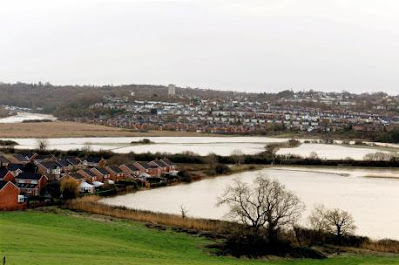
A near miss in Newport in 2016

In a warmer wetter world heatwaves and flood events are going to become more common - we need to build into our communities the resilience to cope with flooding.  We need to think and act smarter, and shift the focus from flood prevention to flood avoidance. Our communities, our nation and our world are becoming more prone to extreme weather, torrential downpours and periods of warmer or hit dry weather. 


Dealing with the consequences of this on a marco level is one thing.  Small relatively simple steps to store water for later use, with water butts (if only to water garden plants and vegetables) can make a very practical if minor use of excessive rainfall and runoff if only very locally.  Aside from helping to save water and to cut water bills.


Local water storage and management is increasingly part of intelligent urban design, something that is becoming more common and necessary in a warmer wetter world.  On a larger scale this is something we will all have to do, naturally some people and nations are a head of the curve when it comes to re-engineering their infrastructures to deal with extreme weather events. 


The concept of the sponge city or urban sponge something that is embedded and central to urban planning should now be coming into its own, particularly in Wales, with our urban areas being redesigned or designed from the start to soak up, and store deluges of torrential rain to prevent damaging and dangerous flash flooding but without the construction of large scale flood defences.  


The Dutch, for historical and geographical reasons have been involved in serious water management for centuries. Yet in a warmed world, even the Dutch are having to take long hard fresh look at how they deal with the consequences or severe weather and more regular flooding along with a rise in sea levels. 


Many urban areas have developed with any serious co side ration of the impact of flash flooding - back in July 2021, in localised parts of London heavy torrential downpours saw local drainage systems overwhelmed - as streets became rivers, homes and businesses were flooded and public transport ( including trains and tubes ) brought to a standstill. In London, heavy rain, which fell on hard surfaces, overloaded drainage and severe flooding resulted. 


There is certain a case that it if happens on London, then Westminster, at least in the short term cannot ignore it, if it happens outside of London then it’s another matter. In Pontypridd the existing flood defences were overwhelmed more than once simply being in poor condition and unable to cope with the sheer volume of water. 


Now elsewhere things are done differently - the sponge city concept has been embraced in parts of Berlin, were green roofs have been created with living plants, mosses and grasses, with plants Boeing on vertical walls, with courtyards planted with vegetation, etc - all of which helps to hold and slow excessive water. One beneficial side effect, if that the retained water helps to cool local neighbourhoods as the water evaporates from vegetation and the ground. 


In the Netherlands, the concept of making room for the river has been embraced to give space for flooding, something which slows the speed of riverine flooding. In Amsterdam, they have constructed rain gardens which have been created from parking areas, which are designed to collect water, people have also been encouraged to remove paving from their gardens, to grow plants and to build ponds to help with runoff and water storage. 


In the city of Rotterdam, public places have been turned into what are called water plazas which turn into shallow lakes during periods of heavy rain, when times are drier these locations are used as public parks and playing fields. Underground car parks have been redesigned or specifically built so that lower levels can be used to store storm related flood waters - which can then be pumped dry when water levels have dropped. 


These concepts are only slowly being looked at a adopted within these islands, we still tend to defy logic and build on flood planes, but, tend not to harden infrastructure of buildings ( commercial and domestic ) or to build with flooding in mind  e.g. build smart using ground floors for storage or parking and raise plug and power points, protect utilities and drains, and put washing machines, fridges sand freezers up off the ground. 


Some urban areas, within these islands, have slowly begun to adopt the concept, there are examples in Llanelli and at West Gordon Park, near Manchester - where porous pavements, shallow depressions, grass berms and small ponds help to absorb and direct surplus water into rain gardens or natural sumps or green spaces that double up as parks in drier periods. 


These are small steps, in a warmer, wetter world with more erratic and extreme weather events the problem of flooding will only get worse. As homeowners pave over their gardens for parking spaces the problem will worsen. The concept of the urban sponge is one that we all need to embrace, along with smart design and smart water management to help to reduce or alleviate urban flooding or we are going to be living with the consequences.